Cities do not lack data, quite the opposite.
Across transportation systems, power grids, water networks, environmental sensors, ports and public services, cities are producing increasingly large volumes of information about how they operate. The harder problem is making that information work together towards urban flourishing.
In many cities, a transit agency describes a disruption differently from a power utility. An environmental researcher may calculate an indicator differently from the city department. Two cities can collect essentially the same measurement while structuring it in ways that make an analytical workflow developed for one difficult to reproduce in the other, limiting cross-city experimentation and learning.
This becomes particularly important as we begin to ask more interesting questions of urban data. What is the current state of a system? What changed and when? What caused the change? Were any interventions implemented, and if yes, did they work? Could an analysis or intervention that worked in one city be tested somewhere else?
The challenge is therefore simply not collecting more data, in as much as digital systems in many cities still need provisioning. The challenge for more flourishing cities extends beyond data collection into developing enough shared structure around that data that systems, researchers and practitioners can understand one another.
That is the problem we built RESCO, the Reduced Set City Ontology, to explore. RESCO provides a lightweight, extensible semantic model for monitoring urban systems, designed around a small number of concepts that can be reused across different cities and domains.
A minimalistic, foundational language for observing cities
One way of thinking about an ontology is as a shared language, which enables shared terms, meaning, and context around those terms.
Without some semantic agreement, integration quickly becomes less about analyzing cities or communities and more about translating between schemas. If two systems use the word measurement, for example, it helps if they mean approximately the same thing. At the same time, there is a danger in solving this problem by attempting to describe everything.
Cities are enormously complicated systems. Transportation alone can include roads, buses, trains, signals, stations, vehicles, operators, passengers, schedules, disruptions and thousands of other concepts. Energy, water, housing, ports, telecommunications and environmental systems each introduce comparable complexity.
Trying to define the entire city upfront can therefore produce an extremely expressive model while making the model increasingly difficult for an ordinary practitioner to implement.
RESCO takes a different approach.
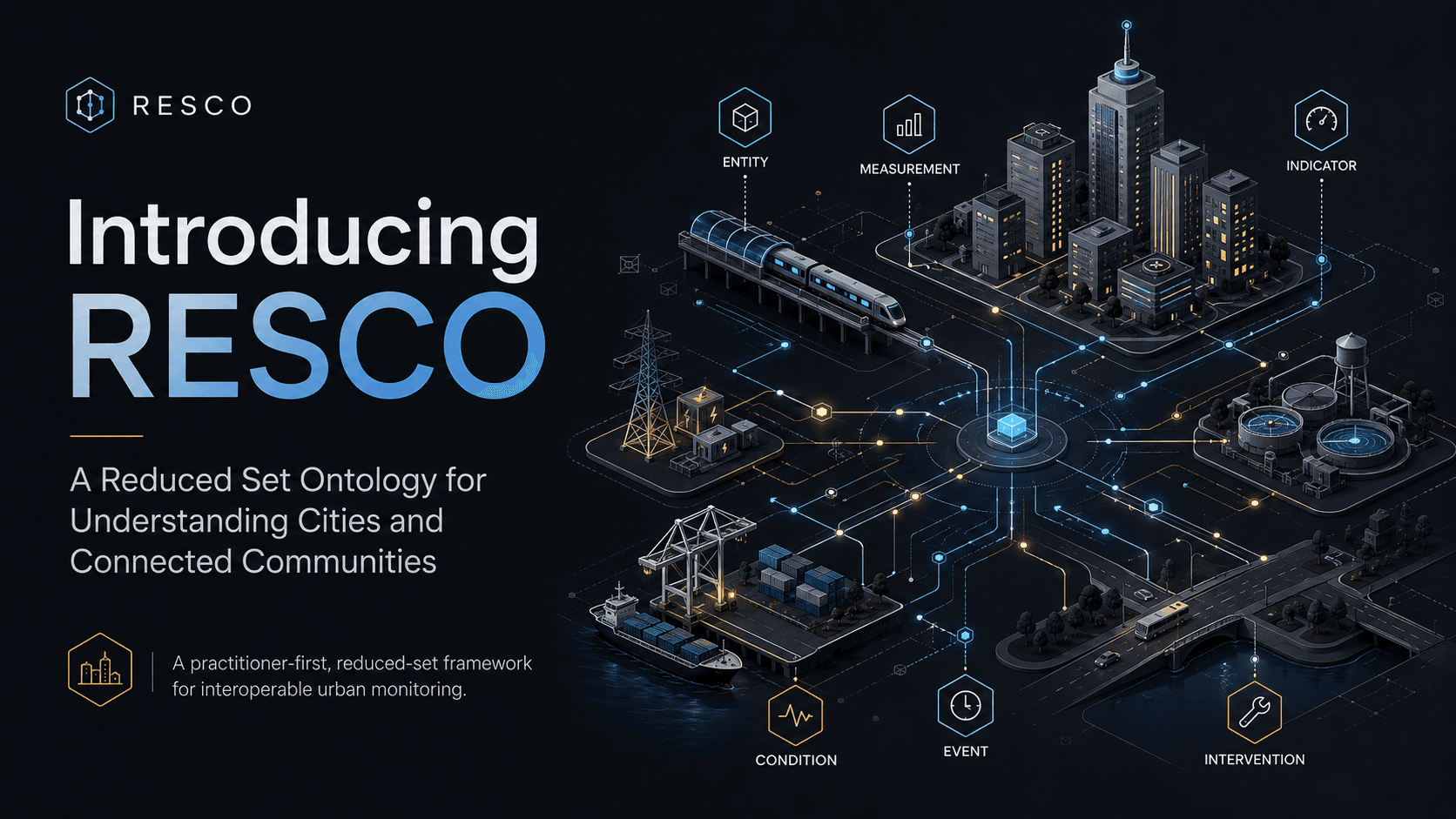
At its core are only six classes: Entity, Measurement, Indicator, Condition, Event and Intervention. An Entity represents something being observed: perhaps a bus, sensor, dam, electrical system or organization. A Measurement records an observation. An Indicator turns one or more measurements into an interpretable metric. A Condition describes the state of something. An Event records something that happened. An Intervention describes an action intended to change the state of the system.
Together, they concisely and flexibly enable practitioners to describe and act within a city or connected community.
Urban monitoring systems frequently become very good at describing what happened without providing equally clear structure for what happens next. RESCO's Intervention class allows actions to sit within the same semantic model as the entities, measurements, indicators and conditions that motivated them. An intervention can therefore be connected to the current condition of a system, a desired condition, the indicators on which the decision was based, and eventually its outcome.
For practitioners, that begins to shift the ontology from being merely a way of organizing data toward becoming a useful representation of an operational loop.
Our RISC philosophy for urban data
There is an analogy from computer architecture that captures much of the philosophy behind RESCO.
In very broad terms, RISC architectures begin with a relatively small instruction set and achieve more complicated behavior through the composition of simpler operations. On the other hand, architectures such as x86 historically lean toward a much larger and richer instruction set, providing more functionality directly within the architecture itself.
RESCO aligns with the RISC design philosophy, applying a similar lens to urban systems.
There are existing urban measurement frameworks that attempt to provide broad, comprehensive representations of the city. Frameworks such as the Global Urban Monitoring Framework are valuable precisely because they establish extensive sets of indicators through which urban development can be understood.
RESCO starts from a different question.
Rather than asking, "What is everything a city should measure?" We ask, "What is the smallest useful semantic structure through which many different things a city measures can be represented?"
This means that RESCO does not attempt to standardize the city, instead focusing on providing enough foundational blocks to observe one.
A city can still define its own indicators. A transport operator can extend the model with domain-specific concepts, such as subway stops, terminals or parking lots. A researcher can add properties necessary for a particular experiment.
In this way, different jurisdictions do not have to agree on every dimension of urban life before they can exchange or compare data. They need a sufficiently stable base from which those extensions can grow.
This is reflected in the three principles behind the ontology: minimalism with completeness; reusability & extensibility; and alignment & interoperability. RESCO attempts to preserve enough structure to remain useful while avoiding unnecessary implementation overhead.
The philosophy also reflects Gall's Law: complex systems that work tend to evolve from simpler systems that worked. Rather than defining an exhaustive urban model under the assumption that every relevant concept can be anticipated beforehand, RESCO provides a core that can be progressively extended as the needs of the system become clearer.
Importantly, reduced does not mean isolated.
RESCO was designed to remain conceptually compatible with standards such as SOSA/SSN and NGSI-LD. Many of its constructs map directly or conceptually onto these existing standards, while RESCO introduces additional structure around areas such as Indicators, Conditions and Interventions that are particularly useful when thinking about monitoring and operational decision-making.
The intention is therefore not to replace the ecosystem around urban data standards, but to reduce the distance between that ecosystem and the people actually trying to use urban data.
Nine cities, Nine very different systems
A reduced ontology is only useful if the reduction survives contact with reality.
We therefore tested RESCO against real-world datasets from nine cities, deliberately choosing different types of urban systems and different levels of data availability. The applications span climate, energy, water, mobility, infrastructure, housing and ports.
In New York City, we modeled both air-quality data and public transit feeds. In São Paulo, the ontology was applied to air-quality measurements alongside energy production, grid load and supply-demand conditions. London provided traffic disruptions as well as power-grid faults and restoration events.
In Cape Town, we modeled dam levels, water capacity and water-quality measurements alongside municipal service requests involving water, sewerage, electricity and street-light infrastructure. In Nairobi, RESCO was applied to informal matatu routes and stops as well as air-quality sensor data.
The same core model could then be stretched further. In Singapore, we represented weather observations and traffic-camera imagery. In Olsztyn, we modeled apartment offer prices, pushing the ontology into housing and real estate. Bengaluru's EV charging stations provided another infrastructure application, while Barcelona allowed us to model ship docking events at the city's port.
The important part is not simply that these datasets can be put into RESCO.
It is what does not have to change.
A dam in Cape Town and an air-quality sensor in Nairobi are completely different pieces of infrastructure, but both can be Entities. A particulate reading and a reservoir-level reading are very different observations, but both are Measurements. An outage in London and a ship arrival in Barcelona are very different occurrences, but both can be Events.
While domain vocabulary changes, the foundations of the underlying data's structure does not, making it quite easy for practitioners to implement in their day to day while preserving domain-specific context. This is the value of having a reduced set.
Why this matters for practitioners
For us, RESCO is ultimately a practitioner-first project.
Semantic interoperability can sound abstract until it is translated into the problems practitioners encounter every day.
Suppose an analyst builds a workflow for evaluating air quality in New York. How much of that workflow can be reused when examining Nairobi? If a city develops a way of linking infrastructure faults to restoration interventions, can another utility adopt the same analytical pattern? If a researcher claims that a particular intervention improved a system condition, can someone in another jurisdiction reproduce that analysis using similarly structured data?
These are interoperability questions, but they are also questions about implementation cost.
Every bespoke schema introduces translation work. Every locally defined concept that means something slightly different elsewhere makes replication harder. Every analytical pipeline tied too closely to one data model becomes more expensive to move.
A shared semantic base does not eliminate the operational differences for these cities, nor should it.
It gives us somewhere consistent to put them.
That is why the reduced-set approach can be particularly useful in cities where data environments differ substantially. A city should not need the same sensor density, institutional capacity or technical architecture as another city before the two can learn from one another.
RESCO's minimal and extensible structure is intended to make workflows more portable across both data-rich and resource-constrained environments, allowing monitoring methods, analyses and eventually interventions to be tested across jurisdictions rather than continuously rebuilt from scratch.
As more urban systems begin incorporating automated reasoning, machine learning and increasingly capable decision-support systems, the structure surrounding the data matters. The usefulness of those systems will depend not only on how much data is available, but on whether relationships between observations, infrastructure states, events and actions are represented consistently enough to reason about.
RESCO provides one possible foundation for doing so. In our complete research paper outlining the complete specification, we identify integration with machine learning and automated reasoning, as well as applications such as grid monitoring, emergency response and transit scheduling, as areas for further exploration. You can find the complete paper here, and our team can help with implementations. RESCO is also open source.
A foundation, rather than a finished model of the city
There is a temptation when building standards to try to anticipate everything. We have deliberately tried not to do that.
Cities will change. Sensors will change. New infrastructure will appear. Practitioners will ask questions we have not anticipated, and individual communities will have legitimate reasons to represent things differently.
A useful urban ontology should therefore leave room for that uncertainty. RESCO is our attempt to define a stable center without prescribing the entire edge.
Six concepts are unlikely to describe everything there is to know about a city. They are not intended to. But they may be enough to establish a common grammar from which considerably richer systems can be built. And if an air-quality researcher in Nairobi, a water operator in Cape Town, a transport analyst in New York and a grid operator in London can extend their systems differently while continuing to share that underlying grammar, we think that is a useful place to start.
RESCO is less a catalogue of what cities should measure than a grammar for describing what cities already measure, what they might measure in the future, and what they choose to do about it. Welcome to RISC in urban systems. Welcome to RESCO.